
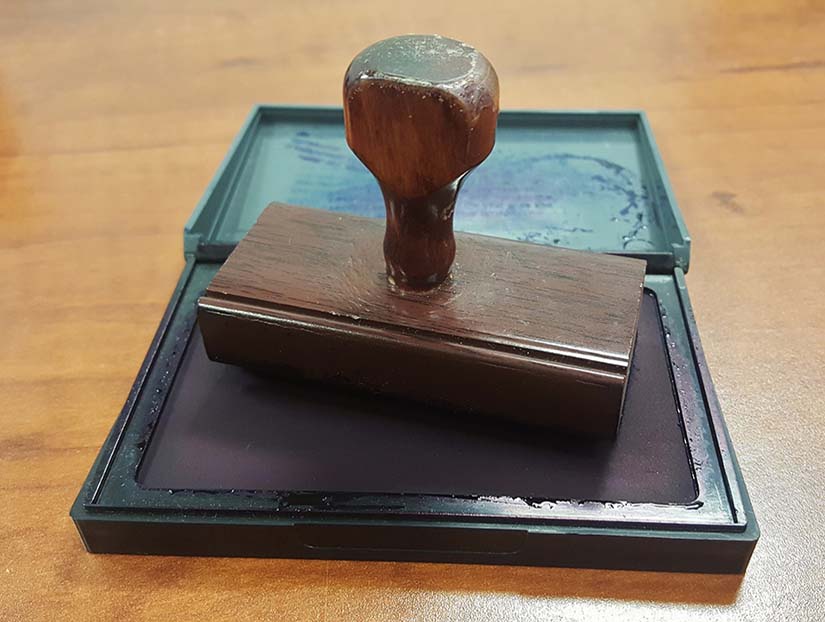
Sharif Ela is a Notary Public. This means he acts as an impartial and legally trained witness to authenticate and certify facts and the valid execution of documents intended for use outside the UK. His signature and seal are recognised as evidence of a responsible legal officer all around the world. Sharif has been a qualified Notary Public since 2016.
Did you know? 3 Facts about Notaries
- There aren’t very many Notaries around! There are approximately only c.700 Notaries in England and Wales.
- The Archbishop of Canterbury is Sharif’s Regulator! The Archbishop of Canterbury appoints Notaries Public on the authority of the Crown. This jurisdiction is exercised through one of the oldest of English Courts – The Court of Faculties.
- Sharif must comply with stringent rules and regulations. Notaries Public must be fully insured and maintain fidelity cover for the protection of their clients and the public. They must keep clients’ monies separate from their own and must comply with stringent practice rules concerning conduct and discipline. Notaries Public are only granted a new Practicing Certificate each year if they have fully complied with all of the rules.
FAQ's
When it comes to business transactions or personal matters with an international dimension, the services of a Notary Public are usually required. The signing of documents before a Notary Public gives the documents recognised legal status in the country concerned.
As a qualified Notary Public based in Ormrods Cleveleys office, Sharif can help with a wide range of matters including:
- Authenticating personal documents as part of an immigration or emigration application, or to apply to marry or to work abroad
- Witnessing powers of attorney for use overseas
- Purchase or sale of land and property abroad
- The administration of the estates of people who are abroad, or who die owning property abroad
- Authenticating company and business documents for overseas transactions
- Certifying personal and business documents for use overseas
- Assisting with legalisation of documents for use overseas
No. A Notary Public is an independent public official, subject to separate professional rules and standards. Whilst a solicitor can be a Notary Public, and in fact Sharif is, they need to have obtained additional qualifications and are separately accredited.
Costs depend on a number of factors, including the type of service required, the type and number of documents involved and for which countries they are needed. In most cases, Sharif can agree a fixed fee for services in advance, giving you real cost certainty.
To arrange for your document to be notarised you will need to:
- Contact Sharif to make an appointment.
- Email a brief summary of the transaction and the document(s) to be notarised in advance for review and comment. Please check these documents carefully before sending for errors such as spelling mistakes, incorrect addresses or wrong name, passport or phone number.
- Provide contact details for the foreign lawyer or authority at whose request you are undertaking this matter along with any documents received in relation to the matter. In advance of the meeting with Sharif send by email copies of valid current ID and bring the originals with you to the meeting with Sharif. Valid forms of ID include:
- Current valid passport
- Photo driving licence
- A bank statement or household utility bill not more than 3 months old, addressed to you at your current home address in the UK
- Usually Sharif will need to add a covering Notarial Certificate to the executed document(s) which he will draft in advance for prior approval by you/the receiving jurisdiction. This will verify Sharif’s qualification as a Notary Public, set out the background to the matter and set out what he has been able to verify. It will be signed, stamped and sealed by Sharif and attached to the front of the executed document(s) and both bound together using ribbon. That completes the notarisation.
When acting for a business client, evidence of the status and authority of the person representing the business entity is required. This may mean that one or more of the following documents will be needed:
- Extract from the Register held at Companies House
- Certificate of Incorporation
- Latest report and audited accounts
- Certified copy of Board Minutes
- Certified copy of Partnership Agreement
- Evidence of being regulated by a regulatory body, such as the Law Society
In addition to the above, each individual signatory will need to produce their individual ID documents as mentioned above.
Sharif will:
- Inspect the originals of your ID documents
- Ask you to demonstrate that you understand the content and effect of the document(s) to be signed and notarised
- Ask you to sign the document(s) in his presence and sometimes before a further witness/witnesses
Each Notarial Certificate that Sharif produces must in each case include essential information, comprising:
- Sharif's full name and practising address.
- The full name and identification details of the client who appears before him and the date and place where he has seen you.
- The date of the Certificate.
- The place where the Certificate has been signed and sealed.
- The nature of the act being witnessed/notarised and setting out very clear exact details of what, precisely, Sharif is certifying or verifying as a Notary Public.
- Sharif’s full signature and his unique seal.
The production of Notarial documents is very important. They have to be substantial and they have to be secure therefore Sharif must:
- Use high quality paper.
- Use ink which is permanent.
- Identify the relevant number of pages each document comprises.
- Not leave any spaces or blank lines.
- If alterations have to be made then these must be initialled by Sharif and by the client signatory.
- Ensure the document is be secure and “tamper proof”.
Sharif ensures that Notarial Certificates are secure by sewing the pages together with green ribbon and using a green legal seal or “wafer” to seal down the ribbon ends over which is applied his Notary Seal.
Staples, wire and heat binding systems must not be used. It is absolutely essential that Sharif’s Notarial Certificate cannot be removed and attached to something else and that the underlying document cannot be removed and replaced with something else. Basically ensuring that every document that leaves his possession is absolutely tamper proof.
The Notarial Certificate will be signed and sealed in respect of your documentation, however the process is not always finished. For each Notarial document, the receiving country will also check:
- That the document meets its own requirements in form and content; and
- That it has been properly signed and certified by a qualified Notary Public.
The only way the receiving Authorities/Officers can check whether the Notary concerned is in fact a qualified Notary and the signature and seal is really his/hers is by the process called Legalisation.
In the simplest terms, Legalisation is the receiving country asking the Government of the sending country to confirm the document is in order and can be accepted and relied upon, by them providing confirmation that the signature and seal of the Notary is genuine.
Although Legalisation/the affixing of the “Apostille” is the last step in the process, it is, in some ways the most critical. It is only the lawyers/officials in the receiving jurisdiction who can confirm and advise regarding legislation requirements and therefore that the document or transaction with which you are concerned is going to be effective in the country intended.
Different Countries have different rules about this. Any of the following could apply:
No Legalisation
Some Countries are happy to rely on documents received and do not even ask about their authenticity or the qualification of the Notary. These tend to be countries that are or have been members of the British Commonwealth/British Empire. Most of these will accept an English Notary’s signature and seal without further enquiry.
The Apostille
The Apostille is a separate piece of white paper, less than A5 size that is glued to the back of my Notarial Certificate, usually somewhere close to my Notarial Seal. The Apostille will include the signature and seal of the Foreign Development and Commonwealth Office on behalf of the British Government. An Apostille is normally required by countries which have become members of the Hague Convention of 1961. Nearly all countries and most states within the USA have joined the Convention.
Before working on your documents, it is necessary for Sharif to ensure that:
- You understand the documents you are signing and their effect on you as an individual or their effect on your business
- What the documents say accurately match your understanding of the transaction to which you or your business are about to commit
In order to check this, he will need at least a basic understanding of the documents. If they are principally in a foreign language, it may be necessary to obtain a translation on your behalf from a qualified translator or ask you to seek separate advice from the lawyer in the foreign country in question. If a translation is required a separate quote for this work will be obtained from the qualified translator and forwarded to you for your consideration and approval.
Contact a Family Law Solicitor